Electricity and life – Galvani experiment with frog legs
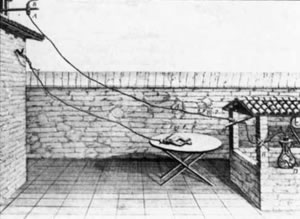 Diagram of Galvani's experiment on frog legs
In the late 1700s, a scientist named Luigi Galvani made a discovery that changed how we understand living things. Galvani was an Italian physician who became famous for a very strange experiment involving frog legs.
The beginning of Luigi Galvani's experiments with bio-electricity has a popular legend which says that in 1771, Galvani was slowly skinning a frog at a table where he had been conducting experiments with static electricity by rubbing frog skin. Galvani's assistant touched an exposed sciatic nerve of the frog with a metal scalpel, which had picked up a charge. At that moment, they saw sparks and the dead frog's leg kicked as if in life. The observation made Galvani the first investigator to appreciate the relationship between electricity and animation — or life. This finding provided the basis for the new understanding that the impetus behind muscle movement was electrical energy carried by a liquid (ions), and not air or fluid as in earlier balloonist theories. (Balloonist theory was a theory in early neuroscience that attempted to explain muscle movement by asserting that muscles contract by inflating with air or fluid.)
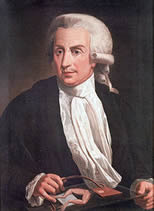 Luigi Galvani Italian scientist famous for pioneering bio-electricity
Galvani coined the term animal electricity to describe the force that activated the muscles of his specimens. This was one of the first forays into the study of bioelectricity, a field that still today studies the electrical patterns and signals of the nervous system.
Why It Was Important
Galvani’s work proved that electricity plays a vital role in how our muscles move and how our bodies function. His experiments sparked a massive scientific debate, eventually leading to the invention of the electric battery by his rival, Alessandro Volta. Today, we know that our own nerves use tiny electrical signals to tell our muscles what to do. Every time you blink, walk, or breathe, you are using the biological electricity that Galvani first observed in that laboratory.
Galvani’s curiosity gave us the foundation to understand the electricity of life, but the modern scientific community has moved toward a more compassionate path. We now recognize that the pursuit of knowledge must be balanced with a profound respect for the life and well-being of all creatures. True scientific progress is measured not just by what we discover, but by how we treat the world while we are making those discoveries.
Galvani died depressed and in poverty
Galvani actively investigated animal electricity until the end of his life. The Cisalpine Republic, a French client state founded in 1797 after the French occupation of Northern Italy, required every university professor to swear loyalty to the new authority. Galvani, who disagreed with the social and political confusion, refused to swear loyalty, along with other colleagues. This led to the new authority depriving him of all his academic and public positions, which took every financial support away. Galvani died in Bologna, in his brother’s house, depressed and in poverty, on December 4, 1798.
Connect two different metals in series with the frog's leg and make Battery
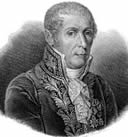 Alessandro Giuseppe Antonio Anastasio Volta
Around 1791 Alessandro Volta began to study the "animal electricity" noted by Galvani when two different metals were connected in series with the frog's leg and to one another. He realized that the frog's leg served as both a conductor of electricity (we would now call it an electrolyte) and as a detector of electricity. He replaced the frog's leg by brine-soaked paper, and detected the flow of electricity by other means familiar to him from his previous studies of electricity. In this way he discovered the electrochemical series, and the law that the electromotive force (emf) of a galvanic cell, consisting of a pair of metal electrodes separated by electrolyte, is the difference of their two electrode potentials.